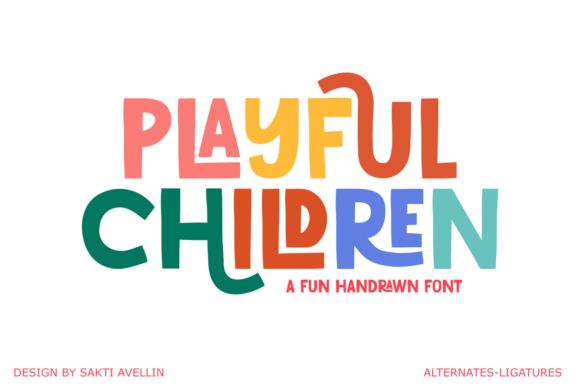
Playful Children: The Font That Captures Kid-Like Wonder
There’s a distinct challenge in design when the audience is children—or the adults who care for them. You need to communicate joy, safety, and imagination without looking amateurish. I’ve spent years sifting through creative font libraries, and a common pitfall is typefaces that try too hard, ending up either saccharine or chaotic. Finding a premium font that balances genuine whimsy with professional execution is rare. Playful Children is one of those rare finds. It isn’t just a collection of letters; it’s a carefully handcrafted typeface that captures the uninhibited energy of a child’s universe while maintaining the structural integrity needed for modern branding.
An Organic Aesthetic with Artistic Flair
When you look at the anatomy of Playful Children, the first thing you notice is the organic flow. Unlike rigid geometric sans serif fonts, this typeface features soft, rounded edges and varying stroke widths that mimic the natural movement of a hand. It strikes a delicate balance—it feels like a handwritten font, but with the consistency required for logo design and editorial headers. The characters aren't just letters; they are little canvases of imagination. The slight irregularities in the baseline and the unique ligatures give it a soul that rigid digital fonts often lack.
However, what sets this apart from standard script fonts is its versatility. It carries a distinctive artistic flair that avoids looking childish in a negative way. Instead, it exudes a sophisticated playfulness. This makes it an incredibly effective tool for visual hierarchy. When you pair Playful Children as your display font against a clean, neutral sans serif font for body text, the contrast creates an immediate focal point. It draws the eye without shouting, guiding the viewer exactly where you want them to look.
Practical Applications: From Branding to Packaging
In my experience, the true test of a creative font is how well it translates across different mediums. Playful Children shines brightest in environments where connection is key. For entrepreneurs in the education sector, this typeface is a game-changer. Imagine a logo for a daycare or a kindergarten; this font instantly communicates a welcoming, safe, and stimulating environment. It builds brand identity before the parent even walks through the door. It works beautifully on signage, staff uniforms, and welcome packets, creating a cohesive visual experience.
For those in product design and packaging, the utility of this font extends to physical goods. I’ve seen similar styles used effectively on snack wrappers, milk cartons, and birthday gift packaging. With Playful Children, you can elevate a mundane wrapper into something that feels special and curated. It’s perfect for "fun size" branding where the typography needs to do the heavy lifting. Furthermore, it translates surprisingly well to merchandise. Think about t-shirt headers, coffee mugs, or wall decals for a child’s room. It turns standard items into keepsakes.
Digital and Editorial Use
Don't limit this typeface to print. In the realm of web design and social media graphics, Playful Children serves as a fantastic tool for grabbing attention in a crowded feed. It is particularly effective for educational mediums—think learning module covers, instructional posters, or interactive PDF worksheets. Because the letterforms are distinct, they can help young readers differentiate characters, aiding in literacy while looking aesthetically pleasing to the adult eye.
Strategic Implementation and Font Pairing
Using a display font like this requires a bit of strategy to maintain professionalism. If you use Playful Children for every line of text, you risk visual fatigue. The key is restraint. Use it for headlines, pull quotes, or branding elements. For body copy, pair it with a highly legible serif font or a geometric sans serif font. A clean font pairing allows the personality of the header to pop without compromising the readability of the message.
Before committing to a project, I always recommend testing the font in context. Type out the specific words you intend to use. Some fonts look great in the alphabet preview but struggle with specific kerning pairs (the space between two letters). Check the readability of your specific message at the size it will be displayed. Additionally, review the included styles. Many premium fonts like this come with alternates or ligatures that can add an extra layer of custom-feel to your design.
Finally, always verify the licensing. If you are using Playful Children for a client’s logo, a commercial product line, or digital assets for sale, ensure you have the appropriate commercial license. It’s a small detail that separates hobbyists from professional designers and protects your business down the line.
In conclusion, Playful Children is more than just a novelty; it is a robust design asset. It bridges the gap between the chaotic energy of childhood and the structured needs of modern marketing. Whether you are crafting a brand identity for a toy outlet, designing a greeting card, or laying out a children’s book, this typeface offers a reliable way to inject joy and creativity into your work. It proves that professional design doesn't have to be sterile—it can be fun, organic, and deeply engaging.