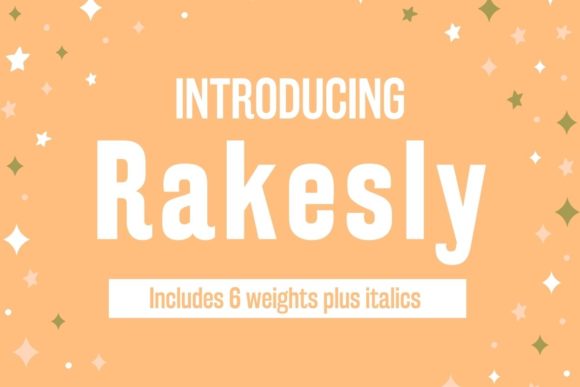
Rakesly: A Modern Take on 19th-Century Grotesque Type
There is a specific kind of authority that comes from the history of typography, a weight that feels both familiar and commanding. When you are building a brand or designing a layout, you need a typeface that carries that history without feeling dated. That is the challenge Rakesly solves. It is a sans serif font deeply inspired by the grotesque headliners of the 19th century, yet it has been refined for the demands of modern typography. It captures the robust, unadorned spirit of early industrial type but strips away the roughness, resulting in a premium font that feels clean, confident, and timeless.
The Anatomy of Rakesly: Strength and Versatility
Rakesly is not a script font or a handwritten font. It is a workhorse display font designed to make a statement. Its visual characteristics are defined by moderate contrast and slightly condensed proportions, giving it a density that commands attention in headlines. Unlike some geometric sans serifs that can feel cold or sterile, Rakesly retains a humanist touch in its curves and terminals. This subtle warmth makes it approachable, while its structural integrity ensures it looks professional.
The real utility of this typeface lies in its extensive family. Rakesly includes 6 weights plus italics, offering a complete spectrum from delicate to heavy. This range is essential for creating a strong visual hierarchy. You can use the Light or Regular weight for body text and subheadings, reserving the ExtraBold or Black weights for massive, impactful headers. This versatility allows a single font family to handle the heavy lifting for an entire brand identity, ensuring consistency across all touchpoints without needing to license multiple disparate typefaces.
Where Rakesly Fits: From Digital Interfaces to Tangible Products
Because of its roots in 19th-century grotesques, Rakesly excels in environments where clarity and impact are paramount. It is a fantastic choice for editorial design, particularly in magazines and blogs where the typography needs to feel authoritative yet easy to read. The sans serif font style ensures that it renders crisply on high-resolution screens, making it a reliable option for web design and mobile applications.
However, its utility extends far beyond the screen. Consider packaging design. When you are standing in a crowded aisle, you have milliseconds to communicate what a product is. Rakesly’s bold weights cut through the noise. It works beautifully for food and beverage branding, cosmetics, and tech accessories. For social media graphics, where users are scrolling rapidly, the strong silhouettes of Rakesly’s uppercase letters stop the thumb. It provides the necessary contrast when paired with a serif font or even a loose script font, creating a dynamic tension that feels curated and professional.
Entrepreneurs and small business owners will find it particularly useful for logo design. A logo needs to be scalable, working just as well on a business card as it does on a billboard. Rakesly’s clean lines ensure it doesn’t get lost at small sizes, while its distinct personality shines when scaled up. It is a commercial font that bridges the gap between playful creativity and corporate seriousness.
Practical Application: Integrating Rakesly into Your Workflow
Adopting a new typeface requires more than just liking how it looks; it requires understanding how it functions within a system. When you choose Rakesly, you are investing in a design asset that prioritizes readability. However, even the best creative font requires careful implementation.
Evaluating Project Fit
Before committing, look at the "personality" of your project. If you are designing a vintage-themed wedding invitation, Rakesly might be too industrial. But if you are creating a tech startup’s landing page, a fashion lookbook, or a modern art gallery’s brochure, its blend of history and modernity is perfect. It conveys innovation and stability simultaneously.
Mastering Font Pairing
Rakesly is a strong team player. For a classic, high-contrast look, pair Rakesly with a transitional serif font. The stark difference in structure creates an immediate focal point. If you want a more contemporary, clean aesthetic, pair it with a humanist sans serif for body copy, using Rakesly strictly for display purposes. Avoid pairing it with other heavy, geometric sans serifs, as they will compete for attention. Let Rakesly be the loudest voice in the room.
Testing and Licensing
Always test your typography in context. Do not just look at the font in a design tool; simulate it on a phone screen, print it out, or view it in a mockup. Check the spacing (kerning and tracking) to ensure your headlines don’t look too cramped. Finally, ensure you have the correct commercial font license for your specific use case, whether that is for a single website or a mass-produced product line.
Final Thoughts on Typography Strategy
In a landscape saturated with generic typefaces, Rakesly offers a distinct voice. It is a premium font that respects the legacy of typographic history while serving the fast-paced needs of modern content creators. Whether you are a designer refining a portfolio, a marketer launching a campaign, or a publisher laying out a book, Rakesly provides the structural foundation needed to communicate effectively. It is more than just letters on a page; it is a tool for building audience engagement and establishing a recognizable, professional presence.